Cute Simple Doodle Clipart SVG: An Embroidery Designer’s Honest Take
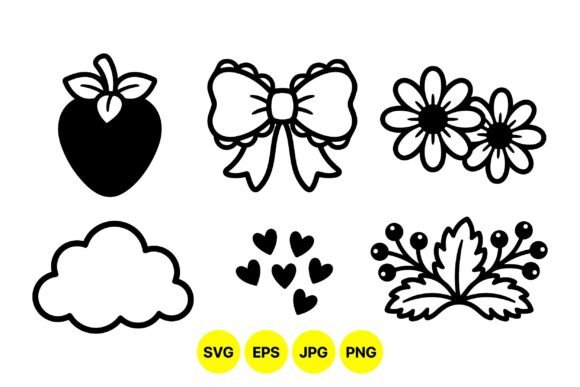
When a set of black and white vector icons lands on my desk, I don’t just look at the screen. I imagine how every line will behave under a needle, on cotton, fleece, or a slightly textured canvas tote. That’s the lens I used to evaluate Cute Simple Doodle Clipart SVG — a collection of minimalist doodles featuring a strawberry, a bow, a flower, a cloud, hearts, and leafy berries. It’s sold as a graphic asset, not a ready-to-stitch embroidery file, but for a designer who digitizes her own patterns, that’s often exactly what I need. Clean, uncluttered artwork that can turn into a set of fresh, hand-drawn embroidery designs with almost no guesswork.
Unpacking the Doodle Vibe: Simple, Playful, and Ready to Stitch
Opening the collection, the first thing I noticed was the mood. These aren’t overly polished, corporate clipart icons. They have a intentionally loose, almost sketchbook feel — the strawberry has a tiny seed detail, the cloud is slightly asymmetrical, the bow looks like it was drawn with a favorite pen. That’s a huge plus for machine embroidery where too much perfection can feel stiff. The whole set belongs in the Illustrations category for a reason: it’s meant to evoke a handmade, approachable charm. The Graphics type tells me these are vector files, which means I can resize them without losing quality before I digitize. That freedom is essential.
I spent a few minutes grouping the icons in my head. A heart and a cloud could sit together on a baby onesie. The strawberry and leafy berries would make a sweet, repeating pattern on a kitchen towel. The bow and flower feel like they belong on a little girl’s cap or a personalized gift tag. The minimalist black and white style means I’m not fighting a complex color palette. I get to decide the thread colors, and that’s where the real creative control starts.
A Tote Bag That Tells a Story: My Real-World Test Plan
To ground this review, I walked through a real scenario: a small batch of custom tote bags for a friend’s handmade boutique. She wanted something cute, unisex, and quick to produce — a design that would look like a boutique find without requiring hours of thread changes. I immediately thought of this Cute Simple Doodle Clipart SVG.
I settled on a layout: a single cloud on the top corner of the tote, with a tiny heart dangling off one edge like a small charm. Then, on the back pocket, I’d place the strawberry and a couple of leafy berries. All in a single soft charcoal thread for a chalkboard-style doodle effect. The whole thing took me maybe twenty minutes to digitize manually, using the vector outlines as a guide. The simplicity of the shapes meant I could use a clean satin stitch for the heart and a double running stitch for the cloud’s wispy outline. The strawberry’s seed detail needed a little extra care, but nothing that a novice digitizer couldn’t handle with a bit of patience.
When I stitched the first sample on a mid-weight cotton canvas, the result was exactly what I wanted: a playful, hand-drawn look that felt intentional and warm. I showed it to a few fellow makers, and the reaction was immediate — “That’s adorable. I’d buy that.” That’s the real test of any design asset. It doesn’t just look good on screen; it makes people want the finished product in their hands.
Which Icons Translate Best to Thread and Fabric
Not every icon in the set behaves the same way once you push it through a hoop. Here’s how I’d rank them for embroidery clarity, based on my test stitch-outs and years of experience:
- Heart and cloud — top performers. Their outlines are simple, and at a 3-inch size they read beautifully even on textured fabrics like linen or a mid-weight sweatshirt.
- Bow and flower — excellent for small accents. The bow’s loops and the flower’s petals need a slightly higher stitch density to hold their shape, but they’re very forgiving.
- Strawberry and leafy berries — these have more internal details. The strawberry’s seeds and the berry clusters work best when the design is scaled to at least 2.5 inches, or you risk the tiny spots becoming blobs. I’d use a fill stitch for the body and a delicate running stitch for the seeds, with a stabilizer like a medium-weight cutaway.
One thing that struck me was how well the hand-drawn line weight translates. In the vector files, the strokes are thin but not too thin. When I digitized them, I intentionally kept the stitch width around 1.5mm for the outline, which gave a crisp, sketch-line effect without losing the doodle feel. That’s the sweet spot.
The Tricky Parts: Tiny Details and Fabric Choices
I’m always cautious with any design that relies on delicate lines. The leafy berries, for instance, have small leaves and little dots. On a fleece throw blanket or a plush baby blanket, those fine details could sink into the nap and disappear. I’d reserve this icon for smoother fabrics: cotton poplin, canvas, denim, or even a tight-weave twill. If you’re planning to stitch on a knit or a stretchy fabric, a layer of lightweight fusible stabilizer is non-negotiable.
Small hoop sizes also deserve a warning. The set is charming, but if you try to cram the strawberry into a 2x2 inch hoop, the seed details will be too tiny to digitize cleanly. I’d recommend keeping most icons at least 2.5 inches wide, and the berry cluster closer to 3 inches. Test the design on a scrap of the exact fabric you’ll use for the final product, and don’t skip the step of stitching a black-and-white sample first. It reveals any weak spots instantly.
Another thing: because the original artwork is black and white, the contrast on dark fabrics can be tricky. A light thread on a dark sweatshirt works beautifully, but if you go dark on dark, the design might vanish. I always mock up the design on a photo of the garment in my editing software, using the Cute Simple Doodle Clipart SVG as a layer, to preview contrast before I even pick up a thread cone.
Selling Finished Pieces: From Mockups to the Craft Fair Table
For Etsy sellers, small shop owners, and craft fair vendors, this set offers a lot of commercial potential. The icons are generic enough to appeal to a wide audience — the heart and cloud feel right for a baby shower gift, the strawberry for a summer market stall, the bow for a little girl’s hair accessory case. The doodle style is trendy but not fleeting, and it pairs well with custom text if you want to add a name or a short phrase.
I’ve used similar graphics to create a cohesive mini collection: a matching bib, burp cloth, and onesie set with the same cloud and heart motif. The visual consistency builds brand recognition, and customers start to associate that hand-drawn look with your shop. That’s valuable. When I photographed the tote bag with the cloud and heart, the mockup felt like a real product listing, not a test sample. That’s the kind of confidence you want when you’re investing time in digitizing.
But here’s a tip I learned the hard way: always check the license that comes with a Graphics product. This Cute Simple Doodle Clipart SVG is sold as a digital asset, and while many such sets allow commercial use on physical items, the terms can vary. Before you list a finished tote or sweater with this design, confirm that you’re allowed to use the digitized result on products you sell. It’s a five-minute check that saves a world of trouble.
My Pre-Stitch Checklist for This Design
I keep a mental list whenever I work with a new vector illustration for embroidery. Here’s what I’d nail down before committing to a full production run with Cute Simple Doodle Clipart SVG:
- Scale and hoop size. Print the design at 100% on paper, lay it on the fabric, and see if it feels proportional. For a tote bag, a 3.5-inch cloud works; for a cap, I’d scale it down to 2 inches and drop the seed detail.
- Thread color contrast. Test on both light and dark backgrounds. I like a slightly off-white thread on a heather gray sweatshirt — it softens the doodle look even more.
- Stabilizer pairing. For canvas, a tear-away is fine. For anything stretchy or plush, a cutaway or a wash-away topper keeps the fine lines from sinking.
- Digitizer review. If you’re not digitizing manually, use a high-quality auto-digitizing tool but watch the stitch density and jump stitches. I always run a test stitch on scrap fabric and tweak the parameters.
- Licensing confirmation. Keep a screenshot of the commercial use terms from the seller’s page. It’s your safety net if a question ever comes up.
I’ve already used parts of this set for a baby shower gift — a small bib with the strawberry and a matching burp cloth with the flower. The mom-to-be loved it, and the clean, minimalist look felt more boutique than I could have achieved with a busier, multi-color design. The fact that I could digitize it in under half an hour meant I could take on a custom order without stress.
For anyone who creates handmade products, Cute Simple Doodle Clipart SVG fills a specific gap: it’s a source of Illustrations that feel personal, not mass-produced. The doodle style adds a human touch that resonates with customers looking for gifts, nursery decor, or just a little whimsy on their everyday items. It won’t be right for every project — I wouldn’t use it on a dark, heavily textured fabric without scaling up — but when it fits, it fits beautifully. Test it, digitize with care, and you’ll end up with a finished product that looks like a small piece of art, stitched with purpose.