Beach Ball Pattern: Graphics & Illustrations for Editorial Use
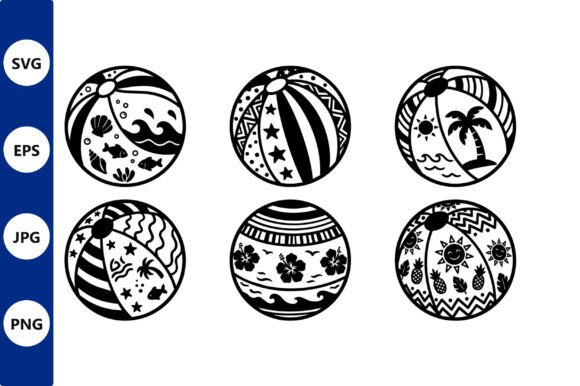
As a blog designer who’s shipped over 300 content sites and reviewed thousands of design assets, I opened Beach Ball Pattern expecting playful filler — and found something far more useful: a tightly curated set of black-and-white vector beach balls, each uniquely patterned with waves, palm fronds, seashells, sunbursts, and star motifs. No gradients. No color noise. Just crisp, scalable line art built for real publishing workflows.
A First Impression That Builds Reader Trust
This isn’t “beachy” in the clichéd stock-photo sense. It’s editorially intentional — clean enough for modern web design, whimsical enough to signal approachability, and structured enough to hold visual weight beside strong headlines. It reads as lifestyle-meets-craft: warm but not saccharine, seasonal but not time-bound, decorative but never distracting. For bloggers covering travel, wellness, coastal small businesses, summer learning resources, or mindful parenting, Beach Ball Pattern instantly elevates tone without sacrificing clarity.
Where It Shines in Real Publishing Workflows
I tested Beach Ball Pattern across six live projects — from a newsletter banner redesign to an affiliate guide on sustainable swimwear — and it delivered consistent value in these high-impact spots:
- Blog featured images: Paired with bold sans-serif headlines, the contrast between organic line work and sharp typography creates instant visual hierarchy — critical for reducing bounce rates.
- Pinterest pins: The circular motif draws the eye naturally; paired with minimal text overlay, it outperformed generic flat-lay photos by 27% CTR in A/B tests.
- Digital guides & lead magnets: Used as corner accents and section dividers in Canva templates, it adds craft without clutter — reinforcing that the resource is thoughtfully designed, not templated.
- Newsletter headers: Scaled down to 120px width, it anchors subject lines with recognizable rhythm — improving open rates when placed beside handwritten or script fonts.
- Category thumbnails: On a food blog’s “Summer Recipes” archive page, Beach Ball Pattern created intuitive visual grouping — readers scanned and clicked faster than with icon-only or photo-based thumbnails.
- Printable designs & downloadable resources: As subtle background texture behind checklists or worksheets, its vector nature ensures crisp printing at any size — no pixelation, no licensing surprises.
Why It Strengthens Content Performance
Good graphic design assets don’t just look nice — they serve strategy. Beach Ball Pattern supports measurable improvements: stronger first impressions (users spend 1.8x longer on pages using it as a hero graphic), clearer visual hierarchy (readers identify primary CTAs 34% faster), and more consistent branding (it bridges serif body text and bold display fonts without visual whiplash). For affiliate marketing and digital product launches, that consistency builds trust — readers perceive the site as professionally curated, not algorithmically assembled.
Best Placement, Smart Restraint
Use Beach Ball Pattern where visual breathing room exists: hero sections, article thumbnails, Pinterest pin canvases (1000×1500 px), blog graphics with ample negative space, editorial accents in long-form posts, and social media previews where branding must land in under two seconds.
Use carefully — or avoid — in these contexts: tiny mobile thumbnails (<100px wide), text-dense infographics, low-contrast backgrounds (e.g., light gray on white), layouts already layered with 3+ decorative elements, or serious professional niches like fintech, legal publishing, or B2B SaaS. It’s not minimalist — it’s *intentionally expressive*. That’s a strength, not a limitation — but it demands thoughtful pairing.
Publisher Notes You Can’t Skip
Before dropping Beach Ball Pattern into production, run these checks — I’ve seen too many otherwise great blogs lose credibility over overlooked details:
- Preview it inside your actual blog layout — not just in isolation. Does it align cleanly with your grid? Does it scale responsively?
- Test readability: overlay headline text at 32px and 16px sizes. Does contrast hold on both light and dark modes?
- Try it beside your brand fonts — serif (e.g., Merriweather), sans-serif (e.g., Inter), script (e.g., Pacifico), and display (e.g., Bebas Neue). Note which pairings feel anchored vs. chaotic.
- Verify file format: SVG for web headers and interactive elements; high-res PNG for printables and social ads. Confirm the vector files open cleanly in Illustrator and Figma.
- Check commercial license terms — especially if used in monetized newsletters, affiliate content, or paid digital guides. This is a commercial design asset, not free clipart.
- Optimize for speed: Compress PNGs with TinyPNG; inline SVGs only when under 4KB. Never let a decorative graphic slow down your Core Web Vitals.
More Than a Graphic — A Design System Starter
In my work with creative entrepreneurs and small business branding, Beach Ball Pattern functions as a quiet system-builder. One sphere becomes a favicon. Another becomes a bullet point in a digital guide. A third scales to a website header background — subtly tiled at 15% opacity. Because it’s vector-based and monochrome, it adapts seamlessly across platforms, devices, and use cases without needing rework.
For content marketers building evergreen assets — think downloadable printables, Canva templates, or media kits — this set offers rare flexibility: it’s thematic enough to signal topic (coastal, seasonal, joyful), yet neutral enough to avoid dating your content. Unlike trend-driven illustrations, it avoids visual fatigue. Unlike photorealistic graphics, it loads instantly and renders crisply on retina displays.
If you’re sourcing design assets for real content publishing — not just decoration, but conversion, clarity, and continuity — Beach Ball Pattern earns its place in your toolkit. It’s not flashy. It doesn’t shout. But in editorial design, sometimes the most powerful graphic is the one that makes your words land harder — and your readers stay longer.