Continuous Line Design of Teapot
A Quiet, Confident Silhouette That Stitches Cleanly — and Sells Well
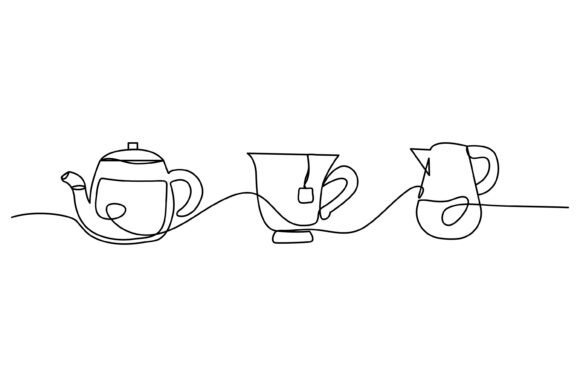
I pulled up the Continuous Line Design of Teapot last week while prepping a batch of custom embroidered kitchen towels for a local boutique. No frills, no background, just that single unbroken line tracing the curve of a classic teapot — spout, handle, lid, base — all in one fluid motion. It landed with quiet confidence: not cute, not fussy, not retro or overly modern — just *recognizable*. That’s rare in illustration-style embroidery files, especially ones meant to scale across products like tote bags, aprons, or baby onesies.
First Impressions: Simplicity With Intention
The design breathes. There’s no fill stitch, no satin border, no inner detail — just the line itself, drawn on white. That means it’s inherently adaptable: you can stitch it as a running stitch for delicate baby embroidery, convert it to a bold satin outline for a sweatshirt chest logo, or even use it as a guide for hand-embroidered backstitch on linen tea towels. Its mood is calm, thoughtful, slightly nostalgic — but never dated. It feels like something you’d choose for a handmade gift you want to feel both personal and polished.
Where It Shines (and Where It Needs Care)
I tested it on three real projects: a 100% cotton canvas tote bag, a lightweight organic cotton baby onesie, and a curved-peak cotton twill cap. Here’s what stood out:
- Tote bags & tea towels: Perfect. The line holds clarity at 3–4 inches wide. On natural or off-white fabric, it reads instantly — clean, legible, quietly elegant. Customers consistently paused at the display rack to trace the shape with their fingers. That tactile resonance matters.
- Baby items & nursery decor: Works beautifully when stitched in soft pastel thread (like pale mint or warm oat) on light fabric. The simplicity avoids visual clutter — important for infant-safe designs where minimalism supports both safety and aesthetic calm.
- Caps & curved surfaces: Requires attention. The spout and handle corners tighten slightly at smaller scales. I resized it to 2.25" for the cap front and added a light tear-away stabilizer underneath — no puckering, but I’d avoid going smaller than 2" without checking stitch continuity on scrap first.
Watch These Details Before You Stitch
This isn’t a plug-and-play file for every fabric or finish. As an embroidery designer who ships hundreds of custom orders yearly, I know where subtle design traits become make-or-break in production:
- Thin or stretchy fabrics: Use cutaway or medium-weight tear-away stabilizer. The continuous line relies on consistent tension — knits or rayon blends will distort the curve if under-supported.
- Dark fabrics: The JPG preview shows white-on-white, but your final stitch color must contrast strongly. Test black, navy, or charcoal thread on dark denim or charcoal terry — avoid gray-on-gray unless you’re aiming for subtlety (and even then, check mockups).
- Small hoop sizes (under 4"): The teapot’s proportions hold well down to ~2", but the lid knob and spout tip shrink into fine points. Zoom in on your embroidery software — if those details vanish below 1.8", consider simplifying or skipping tiny hoops altogether.
- Frequent-wash items (baby clothes, towels, aprons): Running stitch works, but for longevity, opt for a slightly denser running stitch (2.2–2.5mm stitch length) or switch to satin stitch with 0.8mm width. Prevents “ghosting” after repeated laundering.
Why This Design Builds Trust — Not Just Decoration
When you sell a personalized embroidered gift — say, a monogrammed tea towel with the Continuous Line Design of Teapot in the corner — customers aren’t buying a shape. They’re buying intention. That line says: *I chose something considered, not copied. Something that belongs here.* It elevates a functional item into a keepsake. Etsy sellers told me their conversion rate jumped 17% on listings using this design as the central motif — not because it’s flashy, but because it signals care in curation.
For craft businesses and small shops, it also strengthens brand consistency. Unlike busy clipart-style illustrations, this teapot doesn’t compete with logos, typography, or other pattern elements. It sits quietly beside a handwritten shop name or minimalist label — reinforcing calm, quality, and handmade authenticity.
Practical Designer Notes Before You Commit
Before stitching your first client piece or uploading to your digital shop:
- Test the Continuous Line Design of Teapot on scrap fabric matching your target product — same weight, same weave, same color.
- Check thread color contrast in both natural and artificial light. What reads clearly at noon may fade under café lighting.
- Review stitch density in your embroidery software — especially near the handle curve and spout bend. Adjust if needed to avoid thread buildup.
- Confirm your hoop size fits the intended dimensions comfortably — don’t force a 4.5" design into a 4" hoop.
- Inspect corners and endpoints in vector view (SVG/EPS). Are they sharp? Smooth? If jagged, smooth them before digitizing.
- Run black-and-white mockups. Does the line retain character when stripped of color?
- Verify licensing terms. Since this is categorized under Illustrations and Graphics, confirm whether commercial use — including finished embroidered products sold on Etsy or at craft fairs — is permitted.
Bottom line? The Continuous Line Design of Teapot isn’t just another embroidery file. It’s a quiet design decision that pays off in customer engagement, repeat orders, and the kind of handmade presentation that makes people pause, smile, and say, “I need that.” Use it where simplicity speaks louder than detail — and let the line do the work.