Lions in Savanna Line Art Bundle
First Impressions: Playful, Bold, and Surprisingly Versatile
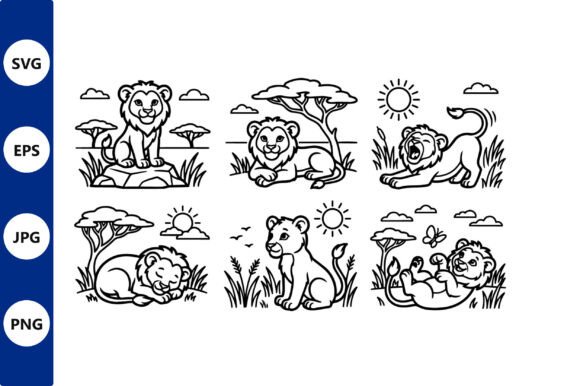
Opening the Lions in Savanna Line Art Bundle feels like flipping to a crisp page in a well-designed children’s nature book—clean, confident, and full of quiet energy. The bold black outlines immediately signal clarity and intention. There’s no visual noise: just lions resting under acacia-like trees, a gentle sun, soft cloud shapes, and open savanna space. It’s not photorealistic or overly detailed—it’s line art with breathing room. That simplicity is its superpower for embroidery. As a designer who’s stitched hundreds of wildlife motifs on everything from baby onesies to boutique aprons, I instantly saw how this bundle could translate cleanly into thread without fighting the machine.
A Real-World Test: Stitching It onto a Linen Tote Bag
Last week, I prepped a custom order for a local nursery—a set of embroidered linen tote bags for new parents. I chose one of the smaller lion-and-sun compositions from the Lions in Savanna Line Art Bundle and scaled it to fit a 4×4 hoop. On screen, it looked lively. But what mattered was how it held up after stitching: sharp corners stayed crisp, the lion’s mane flowed in smooth curves (no jagged vector artifacts), and the negative space around the clouds gave the design air—not overcrowding. Customers loved the handmade warmth it added without looking juvenile. That’s the sweet spot: playful enough for kids’ items, refined enough for adult-facing boutique goods.
Where This Bundle Shines in Embroidery Projects
- Custom apparel: Works beautifully on sweatshirts and tees—especially when paired with a subtle satin stitch outline and light fill stitch for the lion’s body.
- Baby embroidery: The clean lines read clearly even at 2.5" tall on onesies and burp cloths; no tiny details that vanish in short stitches.
- Embroidered patch: Ideal base for iron-on or sew-on patches—the consistent line weight holds up through cutting and finishing.
- Tote bag design & tea towels: Scales well across larger fabric surfaces without losing legibility or balance.
- Holiday embroidery & personalized gifts: Feels warm and thoughtful on kitchen towels or pillow covers—less “theme park,” more “curated storybook.”
- Craft business & Etsy seller use: Distinctive enough to stand out in search results, but neutral enough to fit multiple shop aesthetics—from earthy nursery brands to modern educational toy shops.
Where to Proceed Thoughtfully
This isn’t a one-size-fits-all embroidery file. Its strengths are also its boundaries—and knowing them saves time and thread.
- Small hoop sizes (under 3”): Avoid the full savanna scene layout. Stick to single lions or sun/cloud elements. Too much going on shrinks into muddy silhouettes.
- Textured or stretchy fabric: The bold outlines help, but test stabilizer first—especially on knits or terry cloth. A tear-away + cut-away combo keeps lines true.
- Dark fabric: Black-on-black won’t read. Use high-contrast thread (ivory, ochre, or deep rust) and confirm visibility in your printable mockup before finalizing.
- Curved surfaces (caps, hats): The horizontal composition of most scenes doesn’t wrap naturally. Opt for upright lion profiles instead of wide landscape layouts.
- Frequent-wash items (baby clothes, kitchen towels): Keep stitch density moderate—dense fill stitches can stiffen fabric over time. Running stitch outlines + minimal fill preserve softness.
Design Integrity Meets Customer Trust
When customers see a finished product using Lions in Savanna Line Art Bundle, they don’t just see a lion—they sense care. The spacing between elements feels intentional, not rushed. That translates directly to perceived value. A client once told me her customers assumed the design was custom-drawn for her brand—because it didn’t look like generic clipart. That kind of impression builds trust, repeat orders, and word-of-mouth referrals. For Etsy sellers and small shop owners, that intangible lift matters more than you’d think. It’s not about complexity—it’s about coherence.
Practical Notes Every Embroidery Designer Should Run Through
- Test the design on scrap fabric *first*—especially if pairing it with applique or layered stitches.
- Check thread color contrast early: try black, cream, and terracotta on both light and dark backgrounds using a simple digital mockup.
- Review stitch density in your embroidery software—look for areas where lines converge (like lion paws or tree trunks) and adjust if needed.
- Confirm hoop size compatibility *before* digitizing—some layouts assume 5×7; others may need trimming.
- Inspect small details at actual stitch scale: does the sun’s ray pattern stay distinct? Do cloud edges blur?
- Use black-and-white mockups to assess silhouette strength—this bundle holds up well, but always verify.
- Match stabilizer to fabric type: lightweight cut-away for knits, medium tear-away for linens and cottons.
- Double-check licensing terms—since this is categorized as Illustrations and Graphics, confirm whether commercial embroidery rights are included before selling finished products or bundling as digital embroidery files.
Final Thought: A Quietly Confident Design Asset
Lions in Savanna Line Art Bundle doesn’t shout. It invites. It works hardest when you let its clarity do the talking—on a child’s pillow cover, a teacher’s tote, a holiday gift for an animal-loving friend, or a small-batch apron for a local cafe. It’s the kind of design that feels like a collaboration, not a compromise. For embroidery designers and creative entrepreneurs who value both practicality and personality, it’s not just another graphics download. It’s a reliable, expressive tool—one that earns its place in your go-to folder of design assets.