Vintage Ornamental Tile Set – 9 Elegant
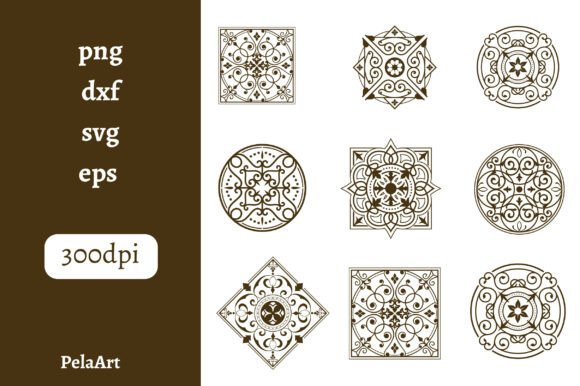
As a designer who’s stitched hundreds of client projects—from boutique baby blankets to limited-run embroidered aprons—I opened the Vintage Ornamental Tile Set – 9 Elegant expecting charm. What I found was something more: nine floral arabesque motifs that feel like heirloom fragments—delicate, intentional, and quietly confident. Not fussy. Not fragile. Just richly composed, with balanced negative space and rhythmic line work that translates beautifully from screen to stitch.
First Impressions: When Ornament Feels Like Intention
This isn’t “vintage” as in faded or distressed—it’s vintage as in *considered*. Each design in the Vintage Ornamental Tile Set – 9 Elegant carries the quiet authority of hand-drawn tilework: symmetrical but never rigid, floral but not cloying, ornamental without sacrificing clarity. The arabesque flow is graceful—not tangled—and the floral elements (think trailing vines, stylized blossoms, subtle palmettes) nestle into corners and curves like they belong there. As an embroidery designer, I immediately saw how these would anchor a tote bag front, frame a pillow cover center, or elevate a tea towel hem. They don’t shout. They invite closer looking.
A Real Project Test: Embroidering a Linen Kitchen Towel
Last week, I used one motif from the Vintage Ornamental Tile Set – 9 Elegant on a heavyweight natural linen towel for a local kitchenware shop. No appliqué—just clean fill and satin stitch, medium density, 3-thread variegated ecru over charcoal linen. The result? Crisp definition even in tight scrolls, zero thread nesting in the inner loops, and a finish that felt artisanal—not digital. Customers paused. Touched the texture. Asked, “Is this hand-stitched?” That’s the power of a well-balanced ornamental design: it reads as handmade, even when machine-embroidered.
Where It Shines (and Where to Pause)
The Vintage Ornamental Tile Set – 9 Elegant excels on stable, medium-to-heavy fabrics: canvas totes, cotton aprons, twill caps, quilt-weight pillow covers. On sweatshirts? Yes—but choose motifs with slightly wider line weight and avoid ultra-fine inner flourishes if stitching over fleece backing. For baby embroidery? Ideal on knit-backed interlock onesies—just pair with lightweight cutaway stabilizer and reduce density by 10–15% to keep it soft.
Use caution on: ultra-stretchy knits (test hoop tension first), dark fabric with light thread (some fine details may soften visually), and curved surfaces like structured caps—opt for the more compact motifs, not the widest, most expansive tiles. Also, skip dense fill areas on thin cotton tea towels unless you’re using tear-away + iron-on hybrid stabilizer. These aren’t flaws—they’re cues. Good design tells you how to respect it.
What It Adds to Your Finished Product
Embroidery isn’t just decoration—it’s perceived value, trust, and intention. A customer paying $48 for a custom embroidered tote doesn’t just want fabric. They want *presence*. The Vintage Ornamental Tile Set – 9 Elegant delivers that. Its cohesion across nine pieces means you can mix-and-match for collections—say, three motifs on matching nursery pillows—or use one as a signature accent for your craft business branding. Etsy sellers will find these especially strong in printable mockups: the clean lines scale well, and the vintage mood photographs authentically, no filters needed.
It also supports professionalism quietly. Unlike overly busy graphics or trendy scripts, these motifs don’t date quickly. They work equally well on wedding guest towels, holiday market aprons, or small shop merchandise tags. And because they’re rooted in tile composition—not lettering or slogans—they translate across languages, cultures, and age groups. That matters when you’re building repeat customers.
Practical Designer Notes Before You Stitch
- Always test on scrap fabric first—especially if pairing with textured weaves or dark backgrounds.
- Review stitch density before hooping. Some motifs have delicate inner scrolls; trimming 5–10% density improves drape on apparel.
- Confirm hoop size compatibility. These are tile-based, so most fit comfortably in a 4×4 or larger hoop—but verify before digitizing for multi-position repeats.
- Inspect small details at actual stitch size. Zoom in on your embroidery software: do those vine tips land cleanly? Are inner petals distinct or merging?
- Test black-and-white mockups. These designs rely on shape and rhythm—not color—so grayscale previews reveal clarity issues faster than full-color renders.
- Match stabilizer to fabric, not just design. Heavy fill areas need firm support; lightweight linens benefit from soft, low-profile cutaways.
- Check licensing terms carefully. Since this is listed as Illustrations/Graphics, confirm whether commercial use of finished embroidered items (e.g., selling on Etsy) is permitted—and whether resale of the digital embroidery file itself is allowed.
Final Thought: Ornament With Integrity
The Vintage Ornamental Tile Set – 9 Elegant stands out because it avoids trend-chasing. It doesn’t try to be modern or retro—it simply *is* elegant. As a working embroidery designer, I reach for it when I need to signal care, heritage, and quiet confidence in a product. Whether you’re stitching personalized gifts, building a small shop’s visual language, or sourcing design assets for digital embroidery files, these nine motifs offer versatility without compromise. They’re not filler. They’re foundation.
If you’re evaluating this set for real project use—whether for custom apparel, baby embroidery, holiday embroidery, or commercial embroidery—trust your eye first, then your machine. Let the design guide your choices, not the other way around. That’s how timeless work begins.