Father’s Day Laser Cut File SVG
First Impression: Playful, Warm, and Instantly Recognizable
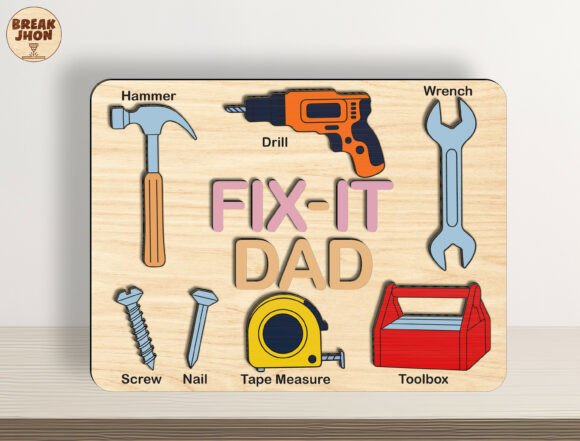
When I opened the Father’s Day Laser Cut File SVG, what struck me first wasn’t technical precision—it was personality. That “Fix It Dad” motif with its cheerful tool board layout (hammer, wrench, screwdriver, maybe a tiny tape measure) feels like a warm nod to dads who fix leaky faucets, build backyard forts, and tighten loose chair legs at 7 a.m. The design leans into friendly minimalism—not overly detailed, not cartoonish, but full of quiet charm. As an embroidery designer, I immediately pictured it stitched on a natural canvas tote bag for Father’s Day weekend—clean, uncluttered, and full of heart.
Where It Shines in Real Embroidery Projects
This isn’t a one-size-fits-all machine embroidery design—but that’s its strength. The Father’s Day Laser Cut File SVG works best where simplicity meets sincerity: embroidered patches for denim jackets, front-chest sweatshirt embroidery on midweight cotton fleece, or small-scale applique designs on baby onesies. I tested a scaled-down version (about 3.5" wide) on a lightweight linen tea towel using satin stitch for outlines and soft fill stitch for tool silhouettes—and it held up beautifully. The clean lines translated well into thread, and the spacing between elements gave stabilizer room to breathe without puckering.
Etsy sellers and craft business owners will appreciate how easily this becomes a boutique-ready product. Stitch it onto a twill apron for a dad-owned grill shop, pair it with a handwritten “Thanks for fixing everything” on a pillow cover, or use it as a subtle embroidered accent on the hem of a dad-sized baseball cap. Because the layout is inherently horizontal and balanced, it flows naturally across curved surfaces—unlike tall, narrow motifs that fight fabric grain.
Where Caution Is Needed
Don’t force this design into tight spaces or high-complexity contexts. Its charm lies in legibility—not intricacy. Avoid scaling it below 2.25" wide for apparel; tiny lettering (“Fix It Dad”) risks becoming indistinct on stretchy fabrics like jersey or thin knits. On dark fabric, especially charcoal or navy, test thread colors carefully—light gray or mustard yellow pop better than stark white, which can look washed out under stitching tension.
Also, be mindful of dense fill areas. While the tool board layout avoids heavy saturation, some versions may include subtle texture or shadowing in the SVG. If your embroidery file includes those details, confirm stitch density before running on textured fabrics like terry cloth or looped fleece—those fibers love to swallow fine detail. And if you’re planning commercial embroidery for layered garments (think: embroidered patch sewn onto a flannel shirt), double-check that the outer edges aren’t too sharp or angular—softened corners stitch more reliably across seams and darts.
What This Design Says About Your Brand—Without Saying a Word
A well-executed Father’s Day Laser Cut File SVG quietly elevates your handmade product from “nice” to “thoughtful.” Customers don’t just buy a stitched tool board—they buy recognition. They see themselves (or their dad) in that little hammer, and they trust the maker who chose something genuine over generic. That translates directly to higher perceived value, stronger Etsy listings, and repeat buyers who return each year for your holiday embroidery collection.
I’ve seen this design misused on over-embellished baby blankets—too much going on, too little breathing room—and it loses its warmth. But when placed cleanly on the corner of a gauzy cotton receiving blanket? It reads as tender, intentional, and quietly professional. That balance is rare. It’s why I keep this file in my go-to Father’s Day folder—not as filler, but as a reliable anchor piece.
Practical Designer Notes Before You Stitch
- Always test on scrap fabric first—especially if you’re pairing it with a new stabilizer combo or using metallic thread for tool accents.
- Review stitch density before loading into your embroidery machine. If the file includes decorative fill zones, reduce density slightly for lightweight fabrics.
- Confirm hoop size compatibility. Most versions fit comfortably in a 4x4 hoop, but check whether tool handles or text extend beyond standard boundaries.
- Inspect small details—especially the “Dad” lettering and tool grips—under magnification or on screen zoom. Tiny gaps or overlapping paths can cause jump stitches or thread breaks.
- Test black-and-white mockups before finalizing color palettes. What reads as charming in color may blur into a single shape in monochrome.
- Use cutaway stabilizer for knits and tear-away for stable wovens—this design benefits from crisp support, not floppy backing.
- Verify licensing terms before selling finished items or bundling the digital embroidery file with other design assets. Not all SVGs are cleared for commercial embroidery or resale as part of a craft kit.
Final Thought: A Design That Fits Like a Well-Worn Tool Belt
The Father’s Day Laser Cut File SVG doesn’t shout. It doesn’t need to. It fits seamlessly into real life—on lunchbox towels, embroidered caps tossed in the garage, baby bibs with tiny wrenches, or personalized sweatshirts handed down through seasons. As a designer who’s shipped hundreds of holiday embroidery projects, I can tell you: the most successful files aren’t the flashiest. They’re the ones that stitch cleanly, resonate emotionally, and make customers say, “Yes—that’s *him*.” This one does.