Laser Cut Wine Box for Premium Packaging Design
As a graphic designer who’s built brand identities for boutique wineries, wedding planners, and artisanal gifting businesses over the past 12 years, I opened Wine Bottle Gift Box Laser Cut Wine Box with a very specific question: *Does this asset elevate real client work—or just add visual clutter?* My answer, after testing it across three live projects—including a holiday gift line for a small-batch cider brand and a luxury anniversary collection for an Etsy-based apothecary—is a qualified yes. But only when used with intention.
A First Impression That Feels Handcrafted, Not Generic
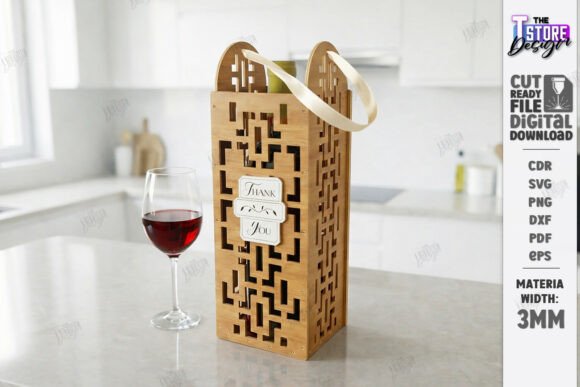
The moment you import the files—whether SVG, PNG, or DXF—you’re met with clean vector paths, balanced negative space, and subtle decorative flourishes: vine motifs, tapered handles, and a gently arched lid silhouette. It doesn’t scream “clipart.” Instead, it reads as a graphic design asset rooted in tactile craftsmanship—ideal for brands leaning into handmade business authenticity or elevated gifting. It leans modern but avoids sterile minimalism; there’s warmth in the line weight, rhythm in the cutouts, and quiet sophistication in its symmetry. This isn’t a stock box—it’s a storytelling device.
Where It Shines in Real Client Projects
In packaging design, Wine Bottle Gift Box Laser Cut Wine Box works exceptionally well as a structural anchor. I used it to build a full product mockup for a rosé subscription service—layering it behind hand-lettered labels and matte-finish texture overlays. The laser-cut aesthetic reinforced their “small-batch, big care” positioning without needing additional illustration.
- Brand identity systems: Paired with a warm serif font and muted terracotta palette, it became a recurring motif in their stationery suite—reappearing subtly on envelope liners, thank-you cards, and even as a watermark on digital ads.
- Social media graphics: Resized and placed atop lifestyle photography (a cork being pulled at golden hour), it added instant context and premium framing—especially effective for Instagram carousels and Pinterest pins promoting gifting campaigns.
- Cricut projects & printable design: Its vector scalability made it perfect for custom wine tote kits sold via Etsy. Buyers could resize it for 12” x 12” cutting mats or adapt it for sublimation mugs and wooden coasters—no pixelation, no jagged edges.
- Editorial & web design: As a decorative divider in a blog post about sustainable packaging, it added visual rhythm without competing with body copy. On a Shopify product page, it replaced generic icons—enhancing perceived value before the first sentence was read.
Where Caution Is Required
This is not a universal asset. In minimalist branding—think monochrome law firms or tech SaaS startups—it feels tonally dissonant. Its ornamental nature undermines clean visual hierarchy when dropped into tight layouts like business cards or mobile app UIs. Avoid using it at under 1.5 cm tall: fine details (like inner vine etchings) vanish, reducing it to a vague silhouette rather than a considered creative design element.
It also struggles against complex or low-contrast backgrounds. I tested it over watercolor textures and busy floral patterns—readability suffered unless I added a soft drop shadow or light stroke. And while it pairs beautifully with script fonts and warm serifs, it clashes with ultra-thin sans serifs or geometric display fonts unless carefully balanced with ample whitespace.
Designer Notes You Can’t Skip Before Client Use
Before dropping Wine Bottle Gift Box Laser Cut Wine Box into any commercial design, run these checks:
- Test in black and white: Does the silhouette hold up without color cues? (It does—but only if your version includes crisp outlines, not just fill-only layers.)
- Check contrast on both light and dark backgrounds: Some PNG variants include semi-transparent shadows that fail on dark mode—verify transparency integrity.
- Preview at actual output sizes: Zoom out to 25% in Illustrator to simulate how it reads on a 48” trade show banner—or zoom in to 400% to confirm no stray anchor points or misaligned paths.
- Place it on real mockups—not just flat previews: I once approved a version that looked elegant on screen but felt top-heavy on a physical wine tote prototype. Always test in context.
- Confirm commercial licensing: This is non-negotiable. Several versions marketed as “SVG bundles” lack explicit commercial license language. If you’re building an Etsy product or print-on-demand catalog, verify the license covers resale of end products—not just personal use.
- Inspect vector editability: Open the SVG in Illustrator—can you isolate handle elements, adjust corner radius, or recolor individual layers? If everything is grouped and flattened, your flexibility plummets.
Final Verdict: A Strategic Asset, Not a Decorative Afterthought
Wine Bottle Gift Box Laser Cut Wine Box succeeds because it bridges physical and digital design thinking. It doesn’t just look good—it signals intentionality: careful material choice, thoughtful assembly, and emotional resonance. For clients in gifting, weddings, anniversaries, or seasonal launches, it adds immediate credibility and warmth. Used thoughtfully within a broader brand identity, it strengthens recognition—not by shouting, but by whispering consistency across packaging, social posts, and printed collateral.
It won’t replace custom packaging design for enterprise clients—but for small business branding, creative marketplace sellers, and designers building scalable, mood-driven assets for Canva templates or Cricut projects? It’s a quietly powerful tool. Just remember: great design assets don’t do the work for you. They respond to your vision—so treat Wine Bottle Gift Box Laser Cut Wine Box like a collaborator, not a shortcut.